

The killing efficacy of ethylene oxide (EO) makes it the ideal method for sterilizing medical devices. However, it is also hazardous to health when it comes to direct contact with people.
In order to ensure safety of the personnel, system operators have an obligation to take appropriate technical and work organization measures (e.g., turn on warning lights, ventilation, interlocking mechanisms) if the EO concentration in working areas is too high. Therefore, continuous recording or measurement of the EO concentration in the operating areas of the EO sterilization system is not only critical, but also necessary to comply with the provisions for occupational safety.
In order to ensure a safe operation, we recommend, based on TRGS 513, to comply with the following EO limits in working areas:
We at STERISYS offer you the necessary equipment, which allows you as the user to take and analyze the respective gas samples. Ethylene oxide is measured with an accuracy of 0.02 ppm. We also offer subsystems (e.g. warning lights, sirens) which automatically generate an alarm when the defined tolerance value is exceeded.
In addition, we will gladly assist you in the creation of a safety concept, which predefines the tolerance and acceptance values and security measures.

Know-how
We offer monitoring systems so that you are able to meet the increasing requirements for the control of EO concentration levels in working areas.
Customized safety concept
We provide you with assistance to develop the optimal safety concept.
Automated actions
When the EO limit is exceeded, safety mechanisms (e.g., fan) are automatically activated.
An EO monitoring system monitors the ethylene oxide (EO) concentration in defined areas around the sterilization system. It helps detect unintended EO releases, warn personnel and trigger defined safety measures.
The specific design of the monitoring system is defined as part of a site-specific safety concept. Applicable national regulations, the risk assessment, the system layout and potential release points are taken into account. The applicable ATEX requirements must also be considered for explosion protection.
STERISYS offers EO monitoring as a project-specific option with every sterilization system. The required systems are determined based on the monitoring technology already in place and the operator’s requirements.
In the gas chromatograph system (GC system), room air is drawn through filtered sampling points and tubing to a central gas chromatograph. A multiplexer selects the individual sampling points one after another. The gas chromatograph separates the components of the air sample and determines the EO concentration.
The measurement process consists of two phases: gas sampling and analysis. The two phases can run in parallel with a time offset. While one sample is being analyzed, the next sample can already be collected. The described system supports distances of up to 100 meters between the sampling point and the central GC system.
The GC system can detect very low EO concentrations and is particularly suitable for monitoring concentration ranges relevant to environmental protection and personnel safety. The specified detection limit is 0.02 ppm.
LEL stands for “Lower Explosive Limit.” The LEL system monitors EO in a higher concentration range and is used to detect a potentially explosive atmosphere and trigger an alarm.
For ethylene oxide in air, 100% LEL corresponds to 2.6% by volume or approximately 26,000 ppm. LEL sensors measure continuously at each measurement point. However, they cannot determine low EO concentrations with the accuracy of a GC system.
The sensors operate on the catalytic bead principle and transmit their measured values to a central evaluation unit or safety PLC. A separate sensor is installed at each measurement point. Depending on the design, the sensor and transmitter can be installed together or separately. The described sensor solution has a response time of less than 20 seconds.
The main difference is the measurement range and therefore the respective monitoring task. The GC system detects very low EO concentrations and is primarily suitable for monitoring environmental and occupational exposure limits. The LEL system measures in a significantly higher concentration range and is used to detect a potentially explosive atmosphere.
In an LEL system, a separate sensor is installed at each measurement point and measures continuously. In a GC system, several sampling points are connected to a central detector by tubing and analyzed one after another. This arrangement reduces the number of detectors required but increases the interval before the same point is measured again as the number of measurement points increases.
Whether a GC system, an LEL system or both systems are used depends, among other factors, on the monitoring technology already in place, the safety concept and the operator’s requirements. When both systems are used, their signals can be combined in a common alarm matrix.
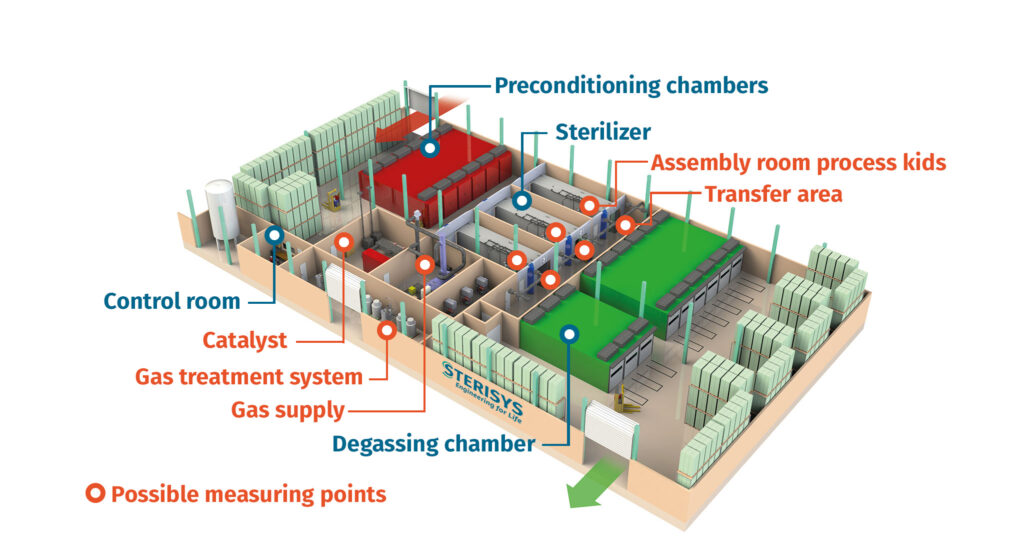
Measurement points are defined for each project. The basis includes an internal STERISYS guideline, risk factors within the rooms, ATEX zoning, experience and the specific system layout.
Typical areas for LEL sensors include:
Typical sampling points for the GC system include:
Not all GC sampling points need to be monitored with the same priority. As each additional sampling point increases the interval before a point is measured again, sampling points may be omitted, multiple points may be installed in one room or measurement sequences may be prioritized differently. This configuration is coordinated with the operator during the sales and planning phase.
The required number is defined based on the internal STERISYS guideline and customized to the system layout, potential EO release points, room risk factors and the site-specific safety concept.
In an LEL system, one sensor is installed for each measurement point. The number depends on the areas that must be monitored for high EO concentrations and a potentially explosive atmosphere.
For the GC system, the number of sampling points that can be connected depends on the selected technical solution.
A project-specific safety concept is the starting point. It defines the acceptance and tolerance values and the associated warning and safety measures. Based on this concept, the number, position and thresholds of the visual and audible alarm devices can be configured.
The current ethylene oxide (EO) monitoring status is continuously displayed by a color-coded signal light. The color indicates the concentration range of the measured value. When defined thresholds are reached, audible warning signals and additional protective measures can be activated. These measures can include locking access to the room, interrupting the EO supply, preventing or terminating a sterilization cycle, activating room ventilation or closing valves.
When the gas chromatograph system and the LEL system are used together, the signals from both systems can be evaluated within a common alarm matrix and linked to the defined responses. Integrated self-diagnostics also monitor the system status and report internal faults.
The GC and LEL systems can be integrated into the central SCADA system. This allows measured values, operating states and alarms from both systems to be displayed and monitored together.
The specific technical connection is defined according to the system configuration and project requirements.
Yes. The collected measured values, system states and alarms can be stored and evaluated later. This allows concentration trends to be tracked and events to be reviewed in detail.
The scope and duration of archiving depend on the selected system solution. Relevant factors include the number of measurement points, the SCADA connection, the presence of an additional LEL system and the decision whether raw data, shift averages or immutable reports are to be stored.
Storage capacity, report format and traceability are defined for each project.

You are currently viewing a placeholder content from Vimeo. To access the actual content, click the button below. Please note that doing so will share data with third-party providers.
More InformationYou are currently viewing a placeholder content from YouTube. To access the actual content, click the button below. Please note that doing so will share data with third-party providers.
More InformationYou need to load content from reCAPTCHA to submit the form. Please note that doing so will share data with third-party providers.
More Information

